

Key takeaways
- Burr wear. Steel conical burrs dull gradually. Signs of wear are longer grind times and a need to adjust finer to keep the same extraction. Baratza and Fellow sell replacement burr sets, so factor in service when comparing brands.
- Cleaning. Remove the upper burr and brush out the chamber every few weeks. Cleaning tablets help with oil build-up, and the chute should be wiped weekly.
- Static and mess. Plastic bins and dry air produce clinging grounds. A grounded metal catch cup or a damp-finger tap on the beans helps.
- Noise. Conical grinders are often quieter than flat designs at the same output, but cheap plastic models still rattle.
- Calibration. After removing and replacing the burrs, the zero point may change. Re-find it by following the manufacturer’s steps rather than guessing.
The best conical burr coffee grinder for most people in 2026 is the Baratza Encore ESP, because it covers both espresso and filter coffee with 40 mm steel conical burrs and 40 grind settings, half of which sit in the espresso range. If you only brew filter coffee, the standard Baratza Encore does the job for less, and if you want one grinder that also handles single dosing with very little waste, the Niche Zero is the enthusiast choice. Conical burrs are popular because they are forgiving, relatively compact, and produce a rounder, heavier cup than most flat-burr designs.
This guide compares seven real conical burr grinders by burr size, adjustment, hopper, retention and the sort of coffee they suit. Figures come from manufacturer pages and retailer listings, and where sources disagree, such as on the burr type of the Breville Smart Grinder Pro, that is noted so you can check the exact version before ordering.
Our top picks


As an Amazon Associate we earn from qualifying purchases at no extra cost to you.
Quick comparison of the seven picks
| Pick | Best for | Burrs | Adjustment | Hopper or dose |
|---|---|---|---|---|
| Baratza Encore ESP | Best overall | 40 mm conical steel | 40 settings, finer steps for espresso | Hopper |
| Baratza Encore | Best for filter only | 40 mm conical steel | 40 settings | Hopper |
| Breville Smart Grinder Pro | Best feature-packed | Conical steel (sources differ) | 60 settings, Dosing IQ timer | Hopper with portafilter cradle |
| Fellow Opus | Best compact all-rounder | 40 mm conical steel | 41 stepped settings | 110 g removable hopper |
| Niche Zero | Best single-dose | 63 mm conical | Stepless dial | Under 30 g |
| Baratza Sette 270Wi | Best grind by weight | Conical | Fine macro and micro steps | Hopper, weight-based dosing |
| OXO Brew Conical Burr | Best low-cost drip | Conical steel | Stepped dial with timer | Hopper |
What conical burrs do differently
A conical burr set has a cone-shaped inner burr that turns inside a ring-shaped outer burr. Beans are pulled down and crushed in stages, which is gentle on the motor and allows a slower, quieter grind than many flat designs. The cut produces a mix of larger particles and a distinct group of fines. Many drinkers like that mix, because the fines add body and sweetness while the main particles give structure. In practice conical grinders are more forgiving of small dosing errors, tend to have less retention when well designed, and stay relatively compact. Flat-burr grinders usually give a cleaner, more separated cup, which is why light-roast fans often choose them. Conical burrs suit medium and dark roasts, milk drinks, and anyone who likes a fuller mouthfeel.
Best overall: Baratza Encore ESP
The Encore ESP uses the same 40 mm conical steel burrs as the standard Encore, but the 40 settings are rearranged so about half of them sit in the espresso range. That is the whole point: finer steps where espresso needs them, and a wider spread at the coarse end for French press and cold brew. Reviews in 2026 consistently name it the best affordable all-rounder, with listings in the mid-range bracket depending on the retailer. Adjustment is stepped rather than stepless, which limits how finely you can dial in a shot.
Who it suits: people who make espresso on an entry-level machine and also brew drip or pour over, and who want one grinder.
Pros: broad range, proven reliability, repairable and widely supported. Cons: stepped adjustment is coarser than an espresso-only grinder, there is some retention in the chute, and espresso on a higher-end machine will want more precision.
Best for filter only: Baratza Encore
The standard Encore remains the usual recommendation for filter coffee. It has 40 mm conical burrs, a straightforward on/off switch and a pulse button, and recommended settings cover drip, pour over, AeroPress and French press. Guides group settings roughly as very fine at 1 to 5, medium-fine at 10 to 15, medium at 15 to 20, coarse at 25 to 30 and very coarse at 30 to 40.
Who it suits: drip and pour-over households that never make espresso.
Pros: lower cost than the ESP, simple operation, durable. Cons: espresso would require settings below the recommended range, so a shot is not realistic. If there is any chance you will buy an espresso machine, pay for the ESP now.
Best feature-packed: Breville Smart Grinder Pro
The Smart Grinder Pro offers 60 grind settings, a digital Dosing IQ timer that adjusts in small increments, and a portafilter cradle for grinding straight into an espresso basket. It is usually priced under the Encore ESP bracket. Most sources describe its burrs as conical stainless steel, although at least one lists them as flat, so check Breville’s own spec page for the version you plan to buy. Some reviewers also criticize the plastic hopper.
Who it suits: beginners who want grind time displayed on a screen, and espresso newcomers who like to grind directly into the portafilter.
Pros: 60 settings, timed dosing, practical accessories. Cons: timer-based dosing does not account for bean density or roast, so doses drift between coffees, and plastic parts are a durability concern. It is not as easy to service as a Baratza.
Best compact all-rounder: Fellow Opus
The Opus has 40 mm stainless conical burrs, a 140 W motor spinning them at about 350 RPM, and 41 stepped settings. It has a 110 g hopper that can be removed for single dosing and a catch cup that holds 100 g. Measured retention is reported at around 0.2 to 0.5 g. It stands about 27 cm tall and weighs roughly 2.3 kg with the cup.
Who it suits: small kitchens and modern counters where looks and footprint matter, and people brewing pour over, French press, moka pot and occasional cold brew.
Pros: low retention for a hopper grinder, compact, wide range, removable hopper. Cons: reviewers note static and plastic parts, and the espresso range is limited, so serious espresso users should look at the ESP or a specialized grinder.
Best single-dose: Niche Zero
The Niche Zero uses 63 mm conical burrs, identical to those in the Mazzer Kony, and a 250 W motor running at 330 RPM. Adjustment is stepless, so you can make fine corrections to a shot. It is built around a hopper that holds just under 30 g, and you load the dose, grind, and repeat. Published retention figures run from about 0.1 to 0.9 g depending on the test. It weighs 4.1 kg and runs at approximately 72 dB.
Who it suits: enthusiasts who change beans often, run espresso on a quality machine, and want minimal waste.
Pros: stepless, low retention, large burrs, versatile from espresso to filter. Cons: significantly more expensive than the Baratza and Breville models, and its small hopper means you dose every time. Some buyers also find it slow for large batches of drip coffee.
Best grind by weight: Baratza Sette 270Wi
The Sette 270Wi is a conical grinder that grinds straight to a target weight, using a built-in scale. Reviewers praise it for the best workflow of the group, because you set the dose in grams, press a button, and it stops at the number. It also has fine adjustment suited to espresso, and cafe-style roundups often name it the best mid-range pick.
Who it suits: espresso drinkers who weigh every dose and want that step automated.
Pros: grinds to weight, fine espresso adjustment, fast. Cons: costs more than the Encore line, and its grind approach produces some retention that you should purge, as with other fast-grind conicals. Confirm the current version’s specifications before you buy.
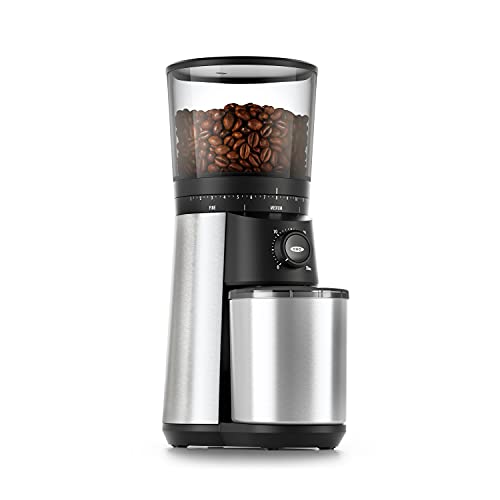
Best low-cost drip: OXO Brew Conical Burr
The OXO Brew Conical Burr Grinder is a budget-friendly choice for drip and pour over. It features a timer dial and a hopper, and it is easy to operate. It will not be able to produce fine espresso grinds.
Who it suits: first-time buyers and households that need a step up from blade grinders.
Pros: easy to use, low cost. Cons: timer dosing is imprecise, and the grind is less even than from premium conicals. It is the right place to start but not the right place to stay if you chase flavor.
How to choose with numbers
Four numbers narrow the field quickly.
- Burr size. A 40 mm burr set handles most households. A 63 mm set such as the Niche’s grinds faster at lower speed and tends to run cooler, which helps preserve aromatics.
- Setting count. More steps give finer control. The Breville has 60, the Encore 40, the Opus 41, and the Niche is stepless. For espresso, you want small steps in the fine range, and that is why the ESP has half its steps there.
- Retention. Under 0.5 g is excellent, one to two grams is typical for hopper grinders, and more than that means noticeable stale grounds.
- Daily dose. If you grind 36 g a day, a 110 g hopper holds three days of beans. A 30 g single-dose hopper means you weigh and load each time, which takes about a minute but guarantees freshness.
A worked cost example: if a grinder retains 2 g and you change beans weekly, you lose 2 g a week, or about 104 g a year, in stale throwaway coffee. At typical specialty bag prices that is only a small amount of money. The reason to care about retention is flavor, not money: the first shot after changing beans carries old coffee. A grinder with under 0.5 g retention largely removes that problem.
Decision matrix by situation
| Your situation | Best match | Reason |
|---|---|---|
| Drip and pour over only, tight budget | Baratza Encore or OXO Brew Conical | Simple, durable |
| Espresso and filter, one grinder, moderate budget | Baratza Encore ESP | Half the steps in the espresso range |
| Want a display and timed dosing | Breville Smart Grinder Pro | 60 settings, Dosing IQ |
| Small kitchen, many brew methods | Fellow Opus | Compact, removable hopper |
| Change beans often, espresso focus | Niche Zero | Stepless, low retention |
| Weigh every dose | Baratza Sette 270Wi | Grind by weight |
Ownership realities
- Burr wear. Steel conical burrs dull gradually. Signs of wear are longer grind times and a need to adjust finer to keep the same extraction. Baratza and Fellow sell replacement burr sets, so factor in service when comparing brands.
- Cleaning. Remove the upper burr and brush out the chamber every few weeks. Cleaning tablets help with oil build-up, and the chute should be wiped weekly.
- Static and mess. Plastic bins and dry air produce clinging grounds. A grounded metal catch cup or a damp-finger tap on the beans helps.
- Noise. Conical grinders are often quieter than flat designs at the same output, but cheap plastic models still rattle.
- Calibration. After removing and replacing the burrs, the zero point may change. Re-find it by following the manufacturer’s steps rather than guessing.
Common mistakes
Many buyers pick a grinder on price alone and then find the adjustment steps too coarse for espresso. Others buy a grinder with a large hopper and leave beans in it for weeks. A third error is overlooking the machine side: an espresso grinder with stepped settings can work well with a pressurized-basket machine, but not with a bare-bones portafilter setup that exposes every grind inconsistency. Finally, skipping the kitchen scale makes almost any grinder seem inconsistent.
Setting up and seasoning a new conical grinder
A new grinder rarely gives its best results straight from the box, and a few simple steps make a visible difference. Start by checking the zero point, which is where the burrs just touch. On Baratza models, the factory calibration is usually close, and the manual explains how to recalibrate if the burrs chirp at the lowest settings. On stepless dials such as the Niche’s, the zero is set by hand and every dial position is relative to it, so mark your favorite settings with a small tape tab or a note.
Next, season the burrs. Fresh steel burrs have tiny machining burrs of their own and can produce slightly uneven grinds for the first kilo or so of coffee. Run a few hundred grams of cheap or stale beans through the grinder before using your good coffee, and vacuum out the chamber afterward. Many owners notice that shot times drift finer during this period, so expect to adjust the grind setting several times in the first weeks.
Finally, build a starting-point table for each brew method. A filter brew that works at setting 18 on an Encore may sit at a different number on the Opus or Breville, so write down each result with the bean, roast date and brew method. Within a month you will have a personal chart that removes most of the guesswork when you change beans.
Grind size by brew method for conical grinders
| Brew method | Target texture | Typical starting zone on a 40-step Baratza | Adjustment tip |
|---|---|---|---|
| Espresso (ESP model) | Fine, like powdered sugar with grit | Low numbers on the espresso-weighted range | Change one step at a time |
| AeroPress | Medium-fine | About 10 to 15 | Finer for short steep times |
| Pour over cone | Medium-fine to medium | About 15 to 20 | Coarser if the bed clogs |
| Flat-bottom drip | Medium | About 18 to 22 | Match the filter basket |
| French press | Coarse | About 25 to 30 | Coarser for less sludge |
| Cold brew | Very coarse | About 30 to 40 | Filter well to catch fines |
These zones are drawn from common manufacturer-style guidance for the Encore family, and other grinders number their dials differently, so treat the texture column as the main guide. Conical burrs create more fines than flat burrs at the same nominal size, so for immersion methods such as French press, going slightly coarser than your first instinct reduces silt in the cup and makes the plunger easier to press.
Upgrading from a blade grinder or a hand mill
Moving from a blade grinder to any grinder in this list is the largest single improvement a home coffee setup can make. A blade chops randomly, so grounds range from powder to chunks, and that spread cannot be fixed with technique. A conical burr crushes beans between two surfaces set at a fixed gap, so particle size follows the dial. Hand-cranked conical grinders also work well and cost less, but at five or six cups a day an electric model saves enough time to justify itself. If you grind for a household with different drinkers, keep a note of each person’s usual setting, because switching between French press and espresso on the same dial is easier with written numbers than with memory.
Frequently Asked Questions
Are conical burr grinders better than flat burr grinders?
Neither is better in every way. Conical grinders are forgiving, quieter and often compact, and they give a rounder cup. Flat grinders tend to give a cleaner cup and are often favored for light roasts. Choose according to the flavor you prefer and the brew methods you use.
Can a conical burr grinder make espresso?
Yes, if it has the right range. The Baratza Encore ESP, Breville Smart Grinder Pro, Niche Zero and Baratza Sette 270Wi are all used for espresso. The standard Baratza Encore and the OXO model are meant for filter coffee.
What is the best conical burr grinder under a moderate budget?
The Baratza Encore ESP is the usual recommendation, with the Breville Smart Grinder Pro and Fellow Opus as close alternatives. Which one is best depends on whether you value stepped settings, a digital timer or a compact footprint.
How often should I replace the burrs?
For a household brewing a few cups a day, steel burrs often last several years. Replace them when grind times grow longer, particle sizes look uneven, or you have to keep adjusting finer for the same shot time.
Why does my conical grinder leave grounds behind?
All grinders retain some coffee in the burr chamber and chute. A small puff of air, a tap on the side or a quick purge of a gram or two moves most of it out. Single-dose models with low retention reduce this problem.
Is a more expensive conical grinder worth it?
If you make espresso daily, yes, because a stepless dial and low retention improve consistency. For drip coffee alone, a mid-range model gets you most of the benefit.


Write Your Review
No reviews yet. Be the first to share your experience!