

Key takeaways
- Hario Skerton Pro review: ceramic hand grinder with 100 g capacity and a stabilized burr. Who it suits, where it falls short and which bundle to pick.
The Hario Skerton Pro is a compact ceramic hand grinder that holds about 100 grams of beans and fixes the burr wobble that held back the original Skerton. It is a solid, inexpensive way to start grinding fresh coffee for pour-over, French press, drip or cold brew. It is not a good tool for espresso, because the grind becomes less consistent at the fine end. This review covers the specifications, the real differences from the older Skerton, who should buy it and which listed bundles and alternatives are worth a look.
Quick Verdict
- Best for: first-time hand-grinder buyers brewing pour-over, French press or cold brew.
- What changed from the original: a burr stabilizer, a simpler grind adjustment under the burrs, a sturdier crank and lid, and a non-slip silicone base.
- Main limit: reviewers do not recommend it for espresso, and coarse grinds are better than before but still not perfectly even.
- Cranking 100 grams takes time, so it suits one or two mugs better than a full pot every morning.
- Several listings bundle it with a V60 ceramic dripper or paper filters, which makes a convenient pour-over starter set.
Key Specs
| Spec | Reported value |
|---|---|
| Model | Hario Skerton Pro (MMCS-2B listing code is commonly cited) |
| Burr type | Conical ceramic; one review gives about 38 mm (confirm on listing) |
| Capacity | About 100 grams of beans; retailers describe enough for up to 8 cups |
| Dimensions | Approximately 167 by 95 by 195 mm |
| Weight | Sources range from about 480 to 650 grams |
| Catcher | Borosilicate glass bowl |
| Handle and body | Hario lists an aluminum handle; some retailers describe other metals (confirm on listing) |
| Cover and lid | Methacrylate resin cover and polypropylene lid |
| Base | Silicone non-slip cover and body ring |
| Usable grind steps | Roughly 10, per one review |
Who It Is For (and Who Should Skip It)
The Skerton has been a default recommendation for first hand grinders for years because the idea is simple: a glass jar, a ceramic burr and a crank. The Pro keeps that idea and corrects the biggest complaint.
A good match if you:
- brew one or two mugs at a time with pour-over, French press, Aeropress-style recipes or cold brew;
- want a low-cost step up from blade grinders or pre-ground coffee;
- like being able to see how much ground coffee you have in the glass jar;
- do not mind turning a crank for a minute or two.
Skip it if you:
- make espresso; reviewers say the grinder can reach fine settings but is inconsistent there;
- need to grind for four or more cups every morning; a larger electric grinder is easier;
- want to travel light, since the glass bowl is breakable and the grinder is taller than compact mills;
- demand precise, repeatable clicks; adjustment is by a threaded dial, not stepped clicks.
What It Does Well
A real fix for burr wobble
The original Skerton had a bottom burr that moved while you ground, especially at coarse settings, producing a mix of particle sizes. The Pro adds a stabilizing mechanism. Sources describe it differently (a stabilizer shaft, a spring or a plate), but all agree that the burr now sits more steadily, and the improvement is clearest on coarser grinds for French press and cold brew.
Easier adjustment
On older models, changing grind size meant disassembling much of the grinder. On the Pro the adjustment dial sits under the burrs, so you can change settings without taking everything apart. That convenience matters when you switch between brew methods.
Practical capacity
One hundred grams is a generous load for a hand mill, and the glass jar lets you see the dose. For one mug of coffee the hopper is more than enough, and for a small French press you can grind in one go.
Improved build
The Pro brings a more durable crank, a hard plastic lid in place of a soft silicone cap and a silicone grip around the base. The grinder stays put when you brace it with one hand, and the lid keeps beans from jumping out.
Easy to pair with a pour-over kit
Several listings combine the grinder with a V60 ceramic dripper or with V60 paper filters. If you are starting from nothing, those bundles cover the main pieces for a first pour-over setup in a single order.
Simple parts and straightforward upkeep
There is little to go wrong: a crank, a shaft, two ceramic burrs, a spring and a glass jar. Disassembly for cleaning takes a minute, and the parts are easy to wipe down with a dry brush. That simplicity is part of the appeal for anyone nervous about gadgets. Keep the grinder dry, store it with the lid on and avoid leaving beans in the hopper for weeks, since oils can build up on the burrs over time.
Where It Falls Short
Not an espresso grinder
Independent reviewers generally advise against it for espresso. It can be set fine, but particle uniformity drops at the fine end, and the threaded adjustment makes small, repeatable changes difficult.
Coarse grinds are better, not perfect
One reviewer notes that coarse settings still show some inconsistency. For French press that can mean a bit more sediment in the cup. A mesh filter or a pour-over method with a paper filter hides it better.
Slow and manual
Grinding 100 grams by hand takes noticeable effort. Expect a minute or two for a mug-sized dose and longer for a full load. People who brew early in the morning sometimes switch to electric for that reason.
Breakable glass
The borosilicate glass bowl handles heat well, but it can chip or break if dropped. Keep it away from counter edges and travel with padding.
Specifications are not consistent across sources
Listings disagree on weight, handle material and some details. Hario’s own page lists an aluminum handle, while a retailer listing mentions a stainless handle. Rely on the manufacturer’s specification and confirm on the listing for the version you are buying.
Setting the grind for common methods
The Pro uses a threaded adjustment under the burrs instead of numbered clicks, so you will find your settings by feel. A practical approach is to tighten the nut until the burrs just touch, then back it off a set number of turns and note the count. Medium-fine suits a cone pour-over, medium suits a flat-bottom dripper, and a coarser setting suits French press and cold brew. Because reviewers describe roughly ten usable steps, small changes are possible but not exact. Write down your counts on a card or in your phone for each method.
Habits that improve the cup
Grind just before brewing, because ground coffee loses aroma quickly. Weigh your dose with a kitchen scale for repeatable results, and grind in steady turns while holding the body firmly. Use the silicone base to brace the grinder against a counter. Brush the burrs now and then, and never rinse the ceramic burrs with soap. Keep a spare filter or mesh handy: coarse grinds on this grinder can produce some fines, and a paper filter or a metal mesh with a gentle pour keeps them out of your mug.
How It Compares
| Grinder | Burrs | Capacity | Adjustment | Notable point |
|---|---|---|---|---|
| Hario Skerton Pro | Ceramic conical | About 100 g | Threaded dial under burrs | Stabilized burr, non-slip base |
| Hario Ceramic Coffee Mill “Skerton” (original) | Ceramic conical | About 100 g (confirm on listing) | Adjusted by removing parts on older versions | Burr wobble reported at coarse settings |
| Hario Ceramic Coffee Mill (Original, Black) | Ceramic conical | Confirm on listing | Confirm on listing | Listing does not say Pro |
| CEVING 60g Large Capacity | Stainless steel per listing | 60 g | 40 external settings | Body material differs between sources |
The Pro is the best of the Skerton line, and the only one this review recommends over the others in the Hario group. If you want finer adjustment and stainless burrs, the CEVING model offers a different design, while the Pro keeps the classic glass-jar look.
Alternatives Worth Considering
Hario Skerton Pro Ceramic Coffee Grinder with V60 Ceramic Pour Over Coffee Maker – the grinder plus a dripper
As an Amazon Associate we earn from qualifying purchases at no extra cost to you.

This listing bundles the Skerton Pro with a Hario V60 ceramic dripper. It is the most complete starter for pour-over, since you need only filters and a kettle. The grinder inside is the Pro covered in this review. The dripper brings its own technique: you will want a slow, steady pour, and paper filters are sold separately unless the listing says otherwise. Confirm the bundle contents and size of the dripper on the page.
Hario Skerton Pro Ceramic Coffee Grinder with V60 Paper Filters – for those who already have a dripper

This bundle pairs the Skerton Pro with a pack of 100 V60 paper filters, according to the listing name. It suits anyone who owns a V60 or a similar cone dripper and wants to replace pre-ground coffee. The grinder is the same one reviewed above. Confirm the filter size and color on the listing so they match your dripper.
Hario Skerton Pro Ceramic Manual Coffee Grinder and V60 Paper Filters in Natural – a second filter bundle

This is another Skerton Pro and filter pairing, with the filters listed as natural, meaning unbleached paper. Some drinkers prefer unbleached filters, though they may need a thorough pre-rinse to remove papery taste. The grinder is identical to the other bundles. If you are comparing the two filter listings, check which filter count and size each includes before choosing.
Hario Ceramic Coffee Mill “Skerton” – the older, cheaper design
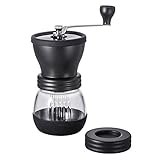
This listing is the original Skerton, sold with Japanese instructions. It uses the same style of ceramic burr and glass jar, but it lacks the stabilizer and easier adjustment that define the Pro. The original is known for burr wobble, especially at coarse settings. Choose it only if the listing is meaningfully cheaper and you mostly brew with methods that tolerate uneven grounds.
Hario Ceramic Coffee Mill Original in Black – the original with a different finish

This second original-style listing is named Original and does not mention Pro. Treat it as an earlier-generation grinder. As with the other original, adjustment requires more disassembly and the burr is less stable. If you see both versions at similar cost, the Pro is the safer choice. Confirm the model on the page, since names can be misleading.
CEVING 60g Large Capacity Manual Coffee Grinder – a different design with external settings

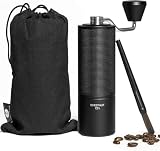
CEVING lists this grinder with 40 external settings, a triple-bearing core and stainless steel burrs, and positions it as holding 60 grams. Sources disagree on the body material, and some versions use ceramic burrs, so read the listing carefully. It is the alternative to consider if you want finer, visible adjustment and a tighter design, and you do not need the Hario glass jar.
Questions
Is the Skerton Pro good for espresso?
Independent reviewers say no. It can be set fine, but particle consistency drops, and small adjustments are hard to repeat. Use it for filter, press and cold brew methods.
How much coffee does it hold?
Hario lists about 100 grams of ground coffee, and retailers describe enough for up to 8 cups. For daily use most people grind a smaller dose per brew.
What is the difference between the Skerton and the Skerton Pro?
The Pro adds a burr stabilizing mechanism, a more durable crank, a hard lid, a silicone base and an adjustment dial under the burrs. The burr set and capacity are broadly the same.
Is the glass bowl safe for hot water?
The bowl is borosilicate glass, which resists heat, but it is meant to catch grounds, not hold hot liquid. Keep water away from the grinder, as moisture can affect the burrs and beans.
How do I clean it?
Dry-brush the burrs and wipe the body. Wash the glass bowl and lid by hand if needed and let everything dry fully before reassembly.
Which bundle should I pick?
Choose the dripper bundle if you are starting from zero, and a filter bundle if you already own a V60 or similar dripper. Confirm the filter size on each listing.
Update History
- October 21, 2026 – Initial publication; specifications checked against manufacturer documentation where available.
- Check the product page for current specifications and availability before buying.
Sources
- Manufacturer product and material information for the Hario Skerton Pro
- Retailer listing titles and specification fields
- Independent hand-grinder review sites comparing the Skerton, Skerton Plus and Skerton Pro



Write Your Review
No reviews yet. Be the first to share your experience!