

Key takeaways
- Burr life. Steel burrs in café grinders are rated for hundreds of kilograms of coffee, which for a household means many years. Replacement is simple on most models, and parts are widely stocked.
- Alignment and calibration. After burr changes, the zero point must be reset. Follow the maker’s guide, because a misaligned set produces uneven grinds.
- Retention. Doser-style grinders hold grounds in the chute. Purge a small amount before the first shot of the day and when you switch beans.
- Noise and vibration. A powerful motor is louder. Place the grinder on a rubber mat to reduce vibration.
- Static. Dry winter air raises static charge on the grounds. Misting the beans lightly with a drop or two of water before they hit the burrs cuts clumping at the chute.
- Electrical. Match the model to your voltage. A grinder made for 240 V will not run correctly on a 120 V outlet, and vice versa.
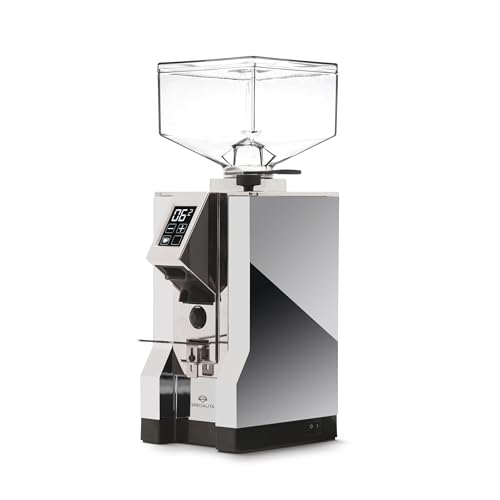
The best commercial-grade coffee grinder for home use is the Eureka Mignon Specialita for most espresso drinkers, and the Mazzer Philos for people who single-dose and want café-level burrs in a compact body. Café machines such as the Mazzer Super Jolly and the Mahlkonig EK43 also work in a home kitchen, but they are larger, louder and more than most households need. The right pick depends on how you brew, how often you change beans, and how much counter space and noise you can live with.
“Commercial” in a grinder usually means three things: larger burrs, a more powerful motor that stays cool under repeated use, and a build designed for years of daily service and repair. At home you rarely need the volume, but you can benefit from the burr quality and the stability. This guide compares seven real grinders by burr size, motor, hopper, retention and ownership realities. Specifications come from manufacturer pages and dealer listings, and some figures such as price and hopper size vary by region and version, so check the exact model before buying.
Our top picks


As an Amazon Associate we earn from qualifying purchases at no extra cost to you.
Quick comparison of the seven picks
| Pick | Best for | Burrs | Motor and speed | Hopper | Weight |
|---|---|---|---|---|---|
| Eureka Mignon Specialita | Best overall for espresso | 55 mm flat steel | 310 W, about 1350 RPM | 300 g (510 g optional) | 5.6 kg |
| Mazzer Philos | Best for single dosing | 64 mm flat steel | 400 W, 1400 RPM at 50 Hz | 60 g | 12.5 kg |
| Mazzer Super Jolly | Best true café grinder | 64 mm flat | Commercial motor | Large hopper | Heavy, large footprint |
| Mazzer Mini Electronic A | Best prosumer step-down | 58 mm flat | Commercial-style motor | Medium hopper | Compact café build |
| Mahlkonig EK43 | Best for filter and espresso at once | 98 mm flat | Very high-capacity motor | Large hopper | Very heavy |
| Baratza Vario+ | Best versatile mid-range | 54 mm flat ceramic (steel optional) | 130 W | About 230 to 300 g, sources vary | About 4.1 kg |
| Niche Zero | Best low-retention conical | 63 mm conical | 250 W, 330 RPM | Under 30 g | 4.1 kg |
What you actually gain from a commercial grinder at home
Larger burrs cut beans with fewer rotations, which keeps heat and fines lower. A stronger motor holds speed under load, so a hard light roast does not slow the burrs. Rigid frames hold alignment, which is why a commercial grinder holds a setting for months where cheaper models drift. The benefits show most clearly with espresso, because tiny differences in particle size change the shot time by seconds. You do not get these benefits automatically, though. A café grinder designed for a dose-and-hold hopper holds old grounds in its chute, and some models retain several grams, so look closely at the way you will use it.
Best overall: Eureka Mignon Specialita
The Specialita has 55 mm hardened steel flat burrs, a 310 W motor turning them at about 1350 RPM, and a 300 g hopper (a 510 g hopper is optional). It weighs 5.6 kg and has a touch display with two timed doses and a continuous mode. Adjustment is stepless micrometric, so you can make very small changes to dial in a shot. Roundups in 2026 name it the most common recommendation for home espresso, citing retention of around 0.3 g and very quiet operation.
Who it suits: home baristas with a semi-automatic espresso machine who want a grinder that behaves like a small café unit without the size or noise.
Pros: quiet, stepless, low retention, compact. Cons: timed dosing is less accurate than weight-based dosing, the touch interface is not for everyone, and prices differ widely between sources, so compare current listings.
Best for single dosing: Mazzer Philos
The Philos pairs 64 mm stainless steel flat burrs with a 400 W motor and a 60 g hopper meant for single doses. Burr speed is 1400 RPM at 50 Hz and 1600 RPM at 60 Hz. It weighs 12.5 kg, so it stays in place, and adjustment is hybrid, offering either 6-micron steps or stepless movement. It ships with I200D burrs tuned for light to medium roasts, with I189D burrs available separately for a fuller body.
Who it suits: enthusiasts who change beans often and want clarity in the cup, since a weighed dose goes in and nearly all comes out.
Pros: café-grade burrs, very rigid, tuned for single dosing, strong brand support. Cons: expensive, heavy, and the small hopper is not suited to households that want to fill a hopper and forget it.
Best true café grinder: Mazzer Super Jolly
The Super Jolly is the grinder many cafés have used for years, and it is rated for high-volume use. It has 64 mm flat burrs, a doser-style or on-demand workflow depending on version, and a large hopper. At home it is simply bigger than a household grinder, both on the counter and in noise.
Who it suits: heavy espresso households, small offices and home cafés that make many shots a day and want a grinder that will last decades.
Pros: durable, parts and service available worldwide, huge capacity. Cons: large footprint, more retention than single-dose grinders, and louder than home models. Not ideal if you drink one or two shots a day.
Best prosumer step-down: Mazzer Mini Electronic A
The Mini Electronic A brings Mazzer’s café design to a more compact body, with 58 mm flat burrs, a timed dosing system and a stainless-steel feel. It has been a long-time favorite among people who want commercial reliability at home without a full-size café unit.
Who it suits: households that grind a few shots each morning and may also use the machine for entertaining.
Pros: proven design, easy to service, consistent grind. Cons: a chute-based design that holds more grounds than a single-dose grinder, so purge a small amount when you change settings or beans.
Best for filter and espresso at once: Mahlkonig EK43
The EK43 uses 98 mm flat burrs and is known worldwide as a café workhorse for filter coffee, where its wide burrs and high speed produce an unusually clear, sweet cup. It can also grind for espresso with the right settings, so one machine covers every brew method. Its size and cost make it a luxury at home.
Who it suits: serious hobbyists who brew pour over and espresso at a high level, and who have both the space and the budget.
Pros: unmatched clarity, huge range, extremely durable. Cons: very large and heavy, loud, expensive, and retention is higher than in compact single-dose grinders, so many owners use it as a weighed-batch tool. It is excess for a single-dose home setup.
Best versatile mid-range: Baratza Vario+
The Vario+ has 54 mm flat ceramic burrs (made by Ditting, with steel burrs as an option), 220 adjustment steps by one listing and 230 by another, and a 130 W motor. It weighs about 4.1 kg and offers programmable timed dosing. The hopper holds about 8 oz (230 g) according to one retailer and 300 g according to another. The Vario W+ adds weight-based dosing.
Who it suits: households that make both espresso and filter coffee and want one grinder that covers both within a moderate budget.
Pros: broad range, repairable, good value. Cons: not truly commercial in build, and espresso dialing is less fine than stepless grinders.
Best low-retention conical: Niche Zero
The Niche Zero uses 63 mm conical burrs, the same as in the Mazzer Kony, and turns them at 330 RPM with a 250 W motor. It is a stepless, single-dose design with a hopper holding just under 30 g. Retention is very low, with published figures between about 0.1 and 0.9 g depending on the test and how you define it. It weighs 4.1 kg and runs at around 72 dB.
Who it suits: espresso fans who switch beans often and want to waste nothing, as well as those who like conical-burr body and sweetness in the cup.
Pros: low retention, stepless, simple workflow, commercial-derived burrs. Cons: small hopper means you dose every time, and the cup is less crisp than flat-burr models in light roasts.
How to size a grinder for your home: a worked example
A household making four double espressos a day at 18 g per shot grinds 72 g daily, or roughly 500 g a week. At that volume a single-dose grinder takes about 5 seconds per dose, which is nothing, so the speed of a big commercial unit buys you no time. What matters is dosing accuracy and retention. If a grinder retains 1.5 g in the chute, then over a week that is 6 doses’ worth of stale grounds cycled through, which is why single-dose designs with low retention cost less in wasted coffee over a year than a larger hopper unit that you fill and leave.
The other number to check is counter size. A Mazzer Philos is about 12.5 kg and a Super Jolly is bulkier still. Measure the height under your cabinets, because tall hoppers and bean tubes can add 10 cm or more, and check that your counter and outlet are near the machine.
Decision matrix by situation
| Your situation | Best match | Reason |
|---|---|---|
| Semi-automatic espresso, one to four shots a day | Eureka Mignon Specialita | Quiet, stepless, compact |
| Change beans often, weigh every dose | Mazzer Philos or Niche Zero | Single-dose, low retention |
| Many shots a day, entertaining | Mazzer Super Jolly | Capacity and durability |
| Espresso and pour over from one grinder | Baratza Vario+ or EK43 | Wide range |
| Prefer proven café design in a small body | Mazzer Mini Electronic A | Commercial reliability |
| Light roasts and maximum clarity | Mazzer Philos with I200D burrs, or EK43 | Flat burrs, large diameter |
Ownership realities of commercial grinders
- Burr life. Steel burrs in café grinders are rated for hundreds of kilograms of coffee, which for a household means many years. Replacement is simple on most models, and parts are widely stocked.
- Alignment and calibration. After burr changes, the zero point must be reset. Follow the maker’s guide, because a misaligned set produces uneven grinds.
- Retention. Doser-style grinders hold grounds in the chute. Purge a small amount before the first shot of the day and when you switch beans.
- Noise and vibration. A powerful motor is louder. Place the grinder on a rubber mat to reduce vibration.
- Static. Dry winter air raises static charge on the grounds. Misting the beans lightly with a drop or two of water before they hit the burrs cuts clumping at the chute.
- Electrical. Match the model to your voltage. A grinder made for 240 V will not run correctly on a 120 V outlet, and vice versa.
Common mistakes when buying commercial grinders for home
The most frequent error is buying for volume rather than workflow. A big hopper is a liability if you drink two shots a day, because beans sit in the hopper and go stale. The second is ignoring the machine side of the equation, since a great grinder paired with an entry-level espresso machine that cannot hold stable pressure will not show its worth. Third is skipping scales: even the best grinder gives its best results with a weighed dose, and a 0.1 g scale costs a fraction of the grinder.
Dialing in espresso on a commercial grinder, step by step
A stepless or micrometric grinder gives you far more room to adjust than a stepped model, which is helpful but also means you need a method. The steps below work on any of the flat-burr grinders in this guide and explain the reason for each.
- Weigh the dose. Start with 18 g in the basket for a double. A weighed dose removes one variable, and the reason to own a precise grinder is to hold the rest constant.
- Aim for a target ratio and time. A common starting point is a 1 to 2 ratio, meaning 36 g of liquid from 18 g of coffee, in about 25 to 30 seconds. This is only a starting point, but it gives you something measurable to adjust.
- Adjust the grind, not the dose. If the shot runs fast and tastes sour or thin, move the grind finer by a small amount. If it runs slow and tastes bitter or harsh, go coarser. On the Specialita and other micrometric grinders, a few small marks on the collar are enough.
- Purge between changes. After changing the setting, grind and discard a few grams so the old grind does not skew your next shot. This is especially important on chute-based grinders that hold a gram or two.
- Record the setting for each bean. Fresh beans usually need a slightly coarser setting as they age and degas, so note the roast date alongside the number.
- Re-check weekly. Temperature and humidity move the optimum, so a setting that worked in winter may need a nudge in a humid summer.
Maintenance schedule that keeps a commercial grinder accurate
Commercial grinders ask for more regular care than home models, but the work is simple. Brush out the burr chamber and chute weekly, since stale oils change the flavor of fresh beans. Every month or two, run grinder cleaning pellets through, or remove the upper burr carrier and clean the burrs with a stiff brush and a dry cloth. Never use water on steel burrs. Every six to twelve months, check the burr alignment and the zero point, because wear changes both. Plan on replacing burrs after a long service life; for the typical home user drinking a few shots a day, that interval can be a decade or more, while a heavy user will see wear sooner as the grind gets inconsistent or takes finer settings to hold the same shot time. Keep a small set of spare parts, such as a hopper lid, a basket and a tamper, and learn how to open the grinder safely with the power unplugged. Following this schedule makes a commercial grinder feel as good in year five as in year one.
Frequently Asked Questions
Is a commercial grinder worth it for home use?
It can be if you drink espresso daily and care about shot consistency. The benefits come from burr quality, stable build and fine adjustment. If you mostly brew drip coffee, a good mid-range grinder such as the Baratza Vario+ gives you most of the benefit for much less money and space.
Which commercial grinder is best for a small kitchen?
The Eureka Mignon Specialita and Niche Zero are the most compact options on this list. The Specialita weighs 5.6 kg and the Niche Zero 4.1 kg, so both fit under standard cabinets with room to spare.
Do commercial grinders need special electrical service?
Most run on standard household outlets in your region, but verify voltage and frequency, because the same model may be sold in 120 V and 240 V versions. Heavy-duty models such as a Super Jolly draw more current, so avoid sharing a circuit with other high-draw appliances.
Can I use a commercial espresso grinder for pour over?
Yes, with limits. The EK43 is famous for filter coffee, and flat-burr espresso grinders can produce good filter grinds at the coarse end of their range. Some espresso-focused models take longer to move between extremes, so a dedicated filter grinder may be easier.
Are conical or flat burrs better for home espresso?
Neither is better outright. Flat burrs usually give higher clarity and are favored for light roasts. Conical burrs tend to give a heavier body and are more forgiving. The Niche Zero shows that a well-made conical can compete with many flat-burr grinders.
How much retention is acceptable?
For single-dose use, under 0.5 g is considered very good. For hopper use, retention matters less because you are continuously cycling beans through, but old grounds can still affect the first shot after a break.


Write Your Review
No reviews yet. Be the first to share your experience!