

Key takeaways
- Burr wear. Steel burrs stay sharp for years of home use, and replacement sets are available for most brands. A grinder that gradually gets slower or needs finer settings to hit the same extraction is a sign of wear.
- Cleaning. Brush the burr chamber weekly and run a grinder cleaning tablet or rice-free cleaning pellets every few months. Never use water on the burrs, since rust forms quickly.
- Retention. Old grounds left in the chamber taste stale. Single-dose grinders reduce this, and you can tap the unit or squirt a puff of air through to push out the remainder.
- Static. A small spritz of water on the beans before grinding, known as the Ross droplet technique, reduces static and mess for many electric grinders.
- Noise. Electric hopper grinders are loud in a small kitchen. Manual grinders are quiet, but you pay in effort.
The best coffee grinder for pour over is the Fellow Ode Gen 2 if you want a dedicated electric brew grinder with flat burrs, and the Baratza Encore if you want a proven conical grinder that costs far less. For manual grinding, the Comandante C40 MK4 is the premium choice and the Timemore C3 is the value choice. Pour over punishes uneven particles more than most methods, because a slow, controlled pour lets fines clog the filter and boulders under-extract, so grind consistency matters more than any other upgrade you can make to a pour-over routine.
This guide compares seven real grinders sold in 2026, gives the specifications that matter for filter coffee, and shows how to match a grinder to your daily volume, budget and tolerance for hand cranking. Specifications come from manufacturer pages and retailer listings, and a few figures vary slightly between sources, so those are marked as approximate.
Our top picks


As an Amazon Associate we earn from qualifying purchases at no extra cost to you.
Quick comparison of the seven picks
| Pick | Best for | Type and burrs | Adjustment | Price tier |
|---|---|---|---|---|
| Fellow Ode Gen 2 | Best overall electric | Electric, 64 mm flat burrs | 31 settings | Premium |
| Baratza Encore | Best value electric | Electric, 40 mm conical burrs | 40 settings | Mid-range |
| Fellow Opus | Best all-rounder | Electric, 40 mm conical burrs | 41 stepped settings | Mid-range |
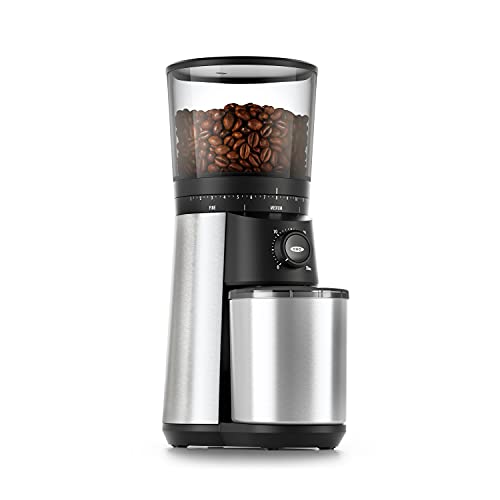
| OXO Brew Conical Burr | Best timed-grind budget | Electric, conical burrs | Stepped dial with timer | Budget to mid-range |
| Timemore Chestnut C3 | Best budget manual | Manual, steel conical burrs | Stepped, about 13 usable steps for the Pro | Budget |
| Comandante C40 MK4 | Best premium manual | Manual, about 39 mm conical burrs | 40 clicks | Premium |
| 1Zpresso ZP6 Special | Best for cup clarity | Manual, burr set tuned for filter | Stepped external dial | Upper mid-range |
Why pour over is picky about the grinder
A pour-over brew usually runs two and a half to four minutes with water passing through the bed under gravity alone. If the grind is uneven, the smallest particles, called fines, dissolve quickly and release bitter compounds, and they also settle at the bottom of the filter where they slow the flow. The largest particles, called boulders, let water pass quickly and give up only a fraction of their flavor, which tastes sour or hollow. Good grinders narrow that spread. Flat burrs usually produce a more even particle size with a clearer cup, while conical burrs produce a slightly wider distribution that many drinkers describe as heavier and rounder. Neither is better in absolute terms, and the right choice depends on the cup you like.
Best overall electric: Fellow Ode Gen 2
The Ode Gen 2 is a brew-only electric grinder with 64 mm flat burrs and 31 grind settings. It is designed for single-dosing, meaning you weigh a dose, pour it into the hopper, and grind it all, which keeps leftover beans from going stale. Reviewers describe it as quiet and low in retention. It stops automatically when the beans are gone. Fellow designed it for filter coffee, so it does not reach true espresso fineness.
Who it suits: pour-over drinkers who care about cup clarity, switch beans often, and want a countertop appliance that looks good.
Pros: flat burr clarity, low retention, quiet, designed for single dosing. Cons: priced well above the entry-level electric grinders, and it cannot grind for espresso. If you ever want to pull shots, this is not the grinder.
Best value electric: Baratza Encore
The Encore is the standard recommendation for new home brewers. It uses 40 mm conical steel burrs, offers 40 grind settings, and has a simple on/off switch with a pulse. The range from about setting 15 to 20 covers medium grinds, with finer settings toward the low numbers and coarse grinds toward the 30s and 40, and many pour-over drinkers settle in the middle of that range for their V60 or Kalita Wave.
Who it suits: anyone starting out with pour over, anyone who needs one grinder for drip, French press and pour over, and people who want a grinder that is easy to service because replacement parts and cleaning guidance are widely available.
Pros: strong reputation for reliability and repairability, wide range, moderate cost. Cons: hopper retention is higher than single-dose grinders, grounds can carry static, and the lowest settings are not suited to espresso. The separate Encore ESP model adds finer steps for espresso, but for pour over only the standard model is necessary.
Best all-rounder: Fellow Opus
The Opus has 40 mm stainless conical burrs, 41 stepped settings, a 110 g hopper that can be removed for single-dosing, and a 140 W motor turning the burrs at about 350 RPM. Its inner ring adds settings beyond the main 1 to 11 range, which extends it toward espresso-adjacent fineness and into coarse cold-brew territory. Reported retention is about 0.2 to 0.5 g.
Who it suits: households that make pour over, French press and the occasional moka pot or cold brew, and want one grinder that covers them all.
Pros: wide range, small footprint, low retention for an electric hopper grinder, compact. Cons: conical burrs give a slightly less clear cup than the Ode, and reviewers mention the plastic bin and hopper, which can build static.
Best timed-grind budget: OXO Brew Conical Burr
The OXO Brew Conical Burr Grinder is a budget-friendly drip and pour-over grinder with a timer dial that lets you set the grind duration. It is mentioned in 2026 roundups as a practical option for people who want to push a button and walk away.
Who it suits: beginners who want a reliable machine and are not yet chasing small differences in the cup.
Pros: easy to operate, affordable, widely available. Cons: timer-based dosing is less precise than weighing, and the grind is less even than flat-burr models, so it is better for forgiving brew styles like a Chemex or auto drip than a fast V60 with light roasts.
Best budget manual: Timemore Chestnut C3
The Chestnut C3 line is the common first hand grinder. It uses steel conical burrs and a compact aluminum body. The Pro version offers around 13 usable grind settings from espresso-fine to French press-coarse, and the catch cup holds roughly 25 g of beans, though reviews quote between 20 and 30 g. That is enough for one strong cup or two lighter ones.
Who it suits: students, travelers, and anyone who wants a very low-cost way to move from pre-ground coffee to fresh grinding.
Pros: affordable, smooth enough crank for the price, compact. Cons: coarser step spacing than premium hand grinders, so fine-tuning the grind is harder, and capacity is small. For two cups you will grind twice.
Best premium manual: Comandante C40 MK4
The Comandante C40 MK4 Nitro Blade is the benchmark premium hand grinder. Its stainless steel conical burrs are about 39 mm (one source says 38 mm), it offers 40 click positions, and it holds about 40 g of beans. The MK4 revision is a small change to the inner frame that stops beans from jamming. Reviewers praise its consistency across the filter range and its durability.
Who it suits: pour-over drinkers who travel, have limited counter space, or simply prefer a ritual, and who are willing to pay for a grinder that can last for many years.
Pros: excellent consistency, 40 g capacity for one or two cups, no power needed, long life with replaceable parts. Cons: premium price, and cranking 40 g of light roast takes noticeable effort, around a minute or more depending on the setting.
Best for cup clarity: 1Zpresso ZP6 Special
The 1Zpresso ZP6 Special is a hand grinder with a burr set tuned for filter coffee, built to deliver a clean, bright cup with light roasts. Roundups name it as the value pick for clarity among manual grinders.
Who it suits: drinkers of light-roast single-origin coffees who care more about separation of flavors than body.
Pros: clarity-focused burrs, external adjustment dial that is simple to change between brews. Cons: manual effort, and some drinkers find the cup thin if they prefer round, heavy coffee. If you want more body, a conical electric such as the Encore or Opus will feel more familiar.
Decision matrix by situation
| Your situation | Best match | Reason |
|---|---|---|
| Brew one or two pour-overs a day, light roasts | Fellow Ode Gen 2 | Flat burrs, single dose, clarity |
| First grinder, small budget, mixed brew methods | Baratza Encore | Wide range, repairable |
| One grinder for pour over plus French press and moka | Fellow Opus | Range and low retention |
| Travel or small kitchen | Comandante C40 MK4 or Timemore C3 | No power, compact |
| Chasing the brightest light-roast cup | 1Zpresso ZP6 Special or Ode Gen 2 | Clarity-tuned burrs |
| Want to press a button and go | OXO Brew Conical Burr | Timer dial |
Starting grind sizes and a worked dialing example
Grind setting numbers are not comparable across brands, so use the descriptions below as a start and adjust by taste. For a V60 or Kalita Wave, aim for a medium-fine grind that feels like table salt to slightly coarser. For a Chemex, go a step or two coarser, close to sea salt. For a flat-bottom auto drip basket, medium is usually right.
- Start with a standard recipe. Use 15 g of coffee to 250 g of water, a ratio of about 1 to 16.7, with water around 93 to 96 degrees Celsius.
- Time the draw-down. A V60 should finish in about two and a half to three and a half minutes including the bloom.
- If it finishes too fast and tastes sour, go one or two settings finer. On a Baratza Encore that means dropping from, say, 20 to 18; on a Comandante, move two to three clicks finer.
- If it stalls and tastes bitter or dry, go coarser by the same increment.
- Change one thing at a time and record the setting. The goal is a repeatable number for each bean, not a perfect number for all beans.
Cost per cup is another reason to value a good grinder. If you drink two cups a day at 15 g each, you use about 11 kg of coffee a year. If a more even grind lets you cut the dose by one gram per cup while hitting the same strength, that saves about 730 g a year, which is several bags of specialty coffee over time.
Ownership realities
- Burr wear. Steel burrs stay sharp for years of home use, and replacement sets are available for most brands. A grinder that gradually gets slower or needs finer settings to hit the same extraction is a sign of wear.
- Cleaning. Brush the burr chamber weekly and run a grinder cleaning tablet or rice-free cleaning pellets every few months. Never use water on the burrs, since rust forms quickly.
- Retention. Old grounds left in the chamber taste stale. Single-dose grinders reduce this, and you can tap the unit or squirt a puff of air through to push out the remainder.
- Static. A small spritz of water on the beans before grinding, known as the Ross droplet technique, reduces static and mess for many electric grinders.
- Noise. Electric hopper grinders are loud in a small kitchen. Manual grinders are quiet, but you pay in effort.
Flat versus conical burrs for pour over
Flat burrs, as in the Ode Gen 2, tend to produce a narrower particle distribution and a clearer, more distinct cup. Conical burrs, as in the Encore, Opus, Comandante and Timemore, tend to produce a bimodal distribution with more fines, which many drinkers find gives a rounder, heavier body. For light-roast fruit-forward coffees, flat burrs are often preferred. For medium and dark roasts, the difference is smaller, and a good conical grinder is entirely satisfactory. Burr size also matters: a larger burr turns more slowly for the same output and generally runs cooler, which helps preserve aroma.
Matching the grinder to roast level and brewer
Roast level changes how much grinder you need. Light roasts are dense and hard, so they resist extraction and reward a grinder that produces few fines, since any fines in a light roast turn the cup harsh while the boulders leave it grassy. A flat-burr model like the Ode Gen 2 or a clarity-tuned hand grinder such as the 1Zpresso ZP6 Special is the natural fit. Medium roasts are the forgiving middle ground, where almost any grinder on this list performs well. Dark roasts are brittle and shatter into more fines, so a conical grinder with a coarser setting, such as the Encore or Opus, keeps bitterness in check.
The brewer matters too. A cone brewer with a single large hole, such as a V60, is sensitive to grind changes because water passes quickly. A flat-bottom brewer like the Kalita Wave slows the flow and tolerates a slightly coarser or less uniform grind. A Chemex uses a thicker filter and wants a coarser, cleaner grind to avoid clogging. If you rotate between all three, a grinder with fine adjustment steps, such as the Comandante with its 40 clicks or the Opus with 41 settings, makes it easier to hop between them without losing your place.
Space, noise and daily volume
Think about where the grinder will live before comparing burr sizes. Electric models like the Ode Gen 2 and Encore need counter space and a power outlet, and the hopper grinders are loud enough at 6 a.m. to wake a household. Manual grinders weigh a fraction as much and fit in a drawer, but cranking 15 g of light roast takes a minute or so, which feels long on a busy morning. As a rough rule, if you brew more than three cups a day or make a full carafe for guests, an electric grinder saves real time. If you brew one or two cups, the manual option costs only a minute and often pays back in flavor per dollar. Households that brew for several people on weekends sometimes keep a hand grinder for travel and a countertop electric for daily use, and that pairing covers almost every situation without duplicating roles.
Frequently Asked Questions
Is a hand grinder good enough for pour over?
Yes. Premium hand grinders like the Comandante C40 MK4 match or beat many electric models on consistency for filter coffee. The trade-off is time and effort, since each batch takes a minute or more of cranking. If you brew one or two cups a day, it is perfectly practical.
Do I need a flat burr grinder for pour over?
No. Flat burrs tend to give a clearer cup, but a conical grinder such as the Baratza Encore makes very good pour over, especially with medium roasts. Choose flat burrs if you mostly drink light roasts and want maximum separation of flavors.
What grind size should I use for a V60?
Start at medium-fine, a little finer than table salt for most grinders, and adjust by taste. If the brew finishes in under two and a half minutes and tastes sour, go finer. If it takes more than four minutes and tastes bitter, go coarser.
Can I use a pour-over grinder for espresso?
Usually not. The Fellow Ode Gen 2 is built for filter only. The Fellow Opus and Baratza Encore ESP can reach finer settings, but a dedicated espresso grinder gives much better control of the fine range.
How often should I clean my grinder?
Brush out the chamber weekly and do a deeper clean every month or two. Oils build up and make fresh beans taste stale, and a clean chamber also reduces clumping and static.
Is it worth upgrading from a budget grinder?
If your current grinder produces visible dust and chunks together, or if you cannot get repeatable results, an upgrade makes a bigger difference to the cup than a new brewer or kettle. If you are happy with the taste, there is no need to change.


Write Your Review
No reviews yet. Be the first to share your experience!